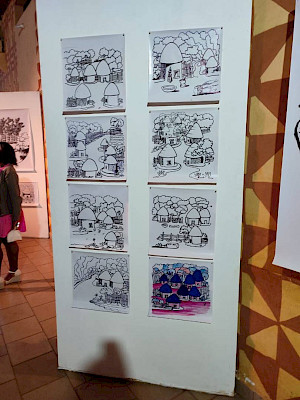
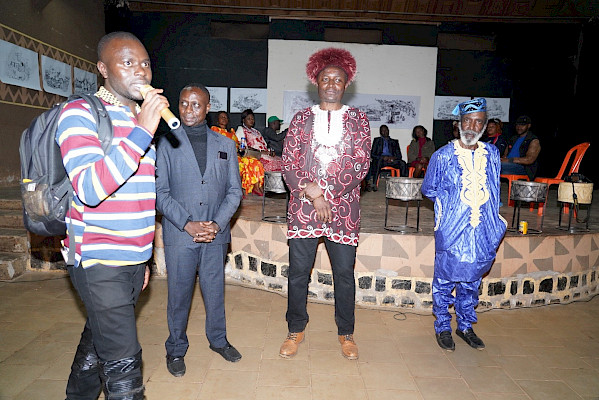
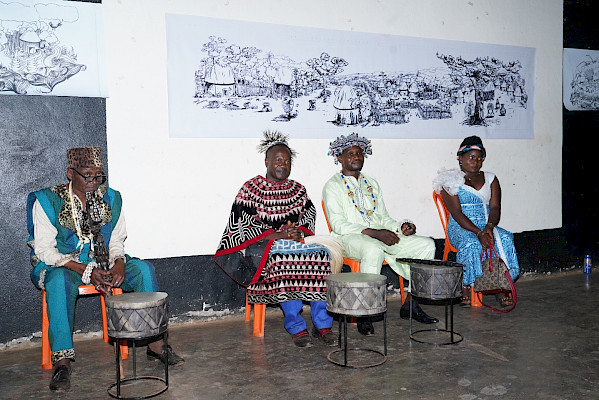
This five-day temporary exhibition from December 5 to 10, 2022 is a unique experience that brings together more than a hundred people for the opening. A moment full of emotions and questions, this exhibition breaks the classic codes of exhibitions from the opening. Indeed, the approach by the drawing in black on white chosen by the artist and his canvases printed on tarpaulins already constitute a dismantling of the classical codes and represent for him a means to engage the reflection with his public and to make of his works, bases being able to be used as didactic tools in the local educational system. An opening attended by the fo'o of the Bafou community whose presence aims to consecrate the artist, his guests and his works.
-
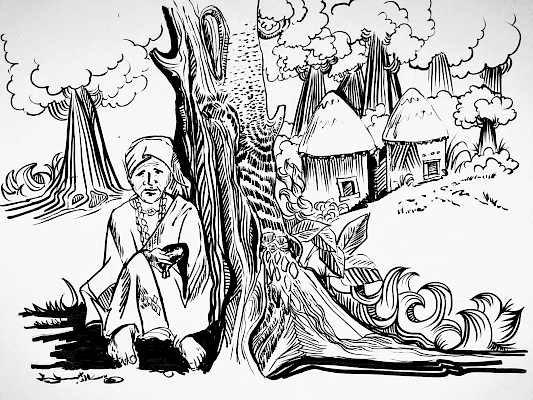 Dessin de Sergio Demefack, à l'encre de Chine
 -
-
-
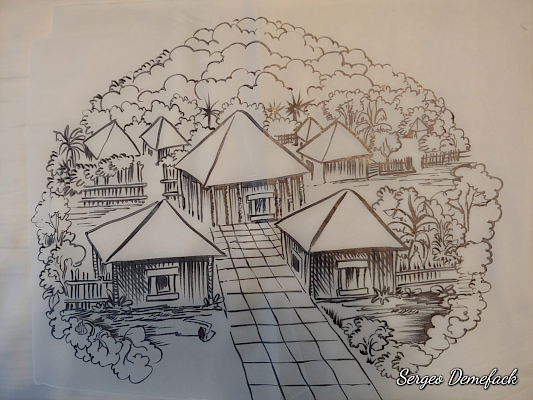 Sergio Demefack,
 -
-
-
Alliance Franco-Camerounaise de Dschang
«Plus que jamais, l'Afrique est appelée à se redécouvrir elle-même en retrouvant les forces qui l'habitent, les dynamiques qui la traversent, les acteurs qui orientent sa vie dans le monde d'aujourd'hui. Elle doit aussi chercher à se comprendre en profondeur en examinant les réponses que les individus et les groupes apportent aux questions qu'ils se posent à partir de la vie quotidienne. À cet égard, il nous faut apprendre à regarder à nouveau le village en Afrique subsaharienne.»
Jean-Marc Ela Innovations sociales et renaissances de l’Afrique Noire. Paris, L’Harmattan, 1998, PP.145.
This reflection by Jean-Marc Ela is an explicit invitation to summon new intelligences and to create new relationships with the village in Africa. The work of the artist Sergeo Demefack follows this logic by creating an imaginary and recomposed universe through drawings.
Visual artist Sergeo Demefack is a Cameroonian-American, lawyer and international development specialist who has traveled throughout Africa (from Morocco to Kenya via Egypt, Senegal, Rwanda and Nigeria) as a consultant, without ever breaking with his artist's hat. He has patiently observed how local cultures are preserved, crossed and revitalized. During more than 20 years of residence in the United States, he continued to create and build an imaginary world through drawings, reminding him of his real and more often composed homeland. His creations articulate strokes, signs and symbols and specifically engage the Bamileke cultural and architectural realities that shaped his childhood. His drawings express the materialities of a separation inscribed in time and an essential connection that links the artist to his land of origin. The uniqueness of his drawings lies in their context of production and their ability to enter the depths of the being and the imagination to produce visible realities, finding a concrete existence on his native land.
Indeed, in a dreamlike or nostalgic state, Sergeo Demefack draws. Beyond his material production and his creation of meaning, the artist's work shakes the boundaries of reality to constitute a virtuous fiber capable of reconnecting it to its cultural and spiritual source. The mixture of his lines sometimes drawn from his memories and very often composite joins Frank Beuvier (2016) to create an affinity between tradition and creation (Creation and tradition. Histoire d'une idéologie de l'art au Cameroun" Revue d'anthropologie et d'Histoire des arts, p. 136-163), and thus participates in a masterpiece that transcends time and space, capable of fertilizing the energies for creative and cultural practices of the future. His sketches aim to re-imagine a metamorphosed universe of his native Bamileke, and allow him to remain connected to his origins from his new home. One can notice that each reality that he lives in his host society leads him to think about his society of departure. In a comparative approach, he remembers, which plunges him into a nostalgia from which drawing is the only way to escape. The collection of drawings is part of a process that promotes reconnection with one's roots and is consistent with the concept of "walking with one's culture".
His artistic expression in Indian ink, which he discovered in Chinatown, participates in the mixing and recomposition that the artist considers important not only as a medium of creation, but especially as an instrument for updating the architectural and cultural dynamism of Bamileke. His exhibition at the AFCD is part of the inverted approach he would like to adopt in response to the externalized creations observed among certain contemporary artists. This exhibition certainly participates in the process of valorization of the contextual cultural heritage deeply rooted in the Bamileke sacred of which he is a tributary and now a protector.
His work creates a resonance between drawings and sculpture and represents for him a didactic tool for the youngest. It is a question for him of offering them the "skeleton" whose imagination could allow them to load these drawings and reinvent themselves, in a combination of mathematics, art, history, culture and architecture.
A DIFFERENT KIND OF EXHIBITION
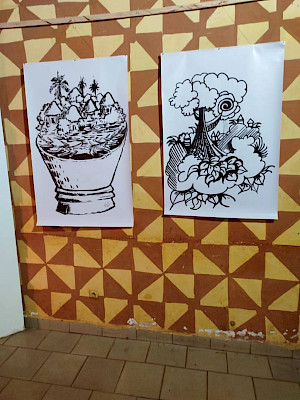
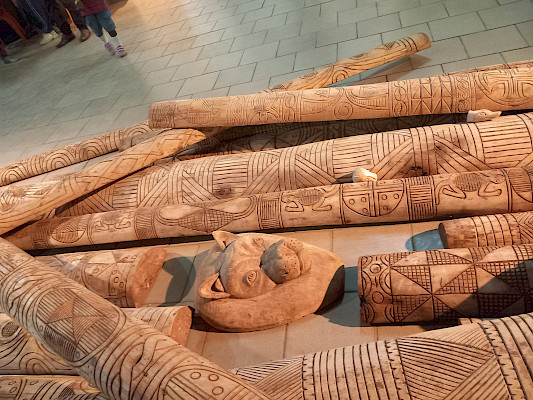
The massive presence of the population from the surrounding villages, the improvisation of the seats actually occupied by these populations and the offer of a cocktail essentially made up of local food, natural juices and local sweets made this moment truly singular, having shaken up the preconceptions, to establish a reflective and engaging context. The mixed-format scenic layout with drawings on both panels and walls and the enclosure of the mural scene by a single canvas, the mixed arrangement in the middle of the room of the gigantic sculpted pillars materializing the chieftaincy and its sacred forest, provoked the visitor to question its historicity, identity and reconnection. The language beyond the image, the meaningful gestures of the majesties present, the improvisations that this presence caused, the music in life, the emotionally charged speech of the artist and a different curatorial style, made this opening and the days that followed an experience that transcended classical norms to create a moment of true personal reconnection of the artist with his native land and his people, and above all, a reconnection of the public to their deepest self. The book of impressions and the instantaneous narrative of some visitors spoke volumes.
The closing of this exhibition with the visit and the work of the artist with the children of the club art kids lessa'a will have been an experimental moment having given to think of the multitude of possibilities and to work the didactic or educational aspect from the drawings and the circumstances of their creations or their steps.
Curated by Dr. Lucie Mbogni Nankeng